
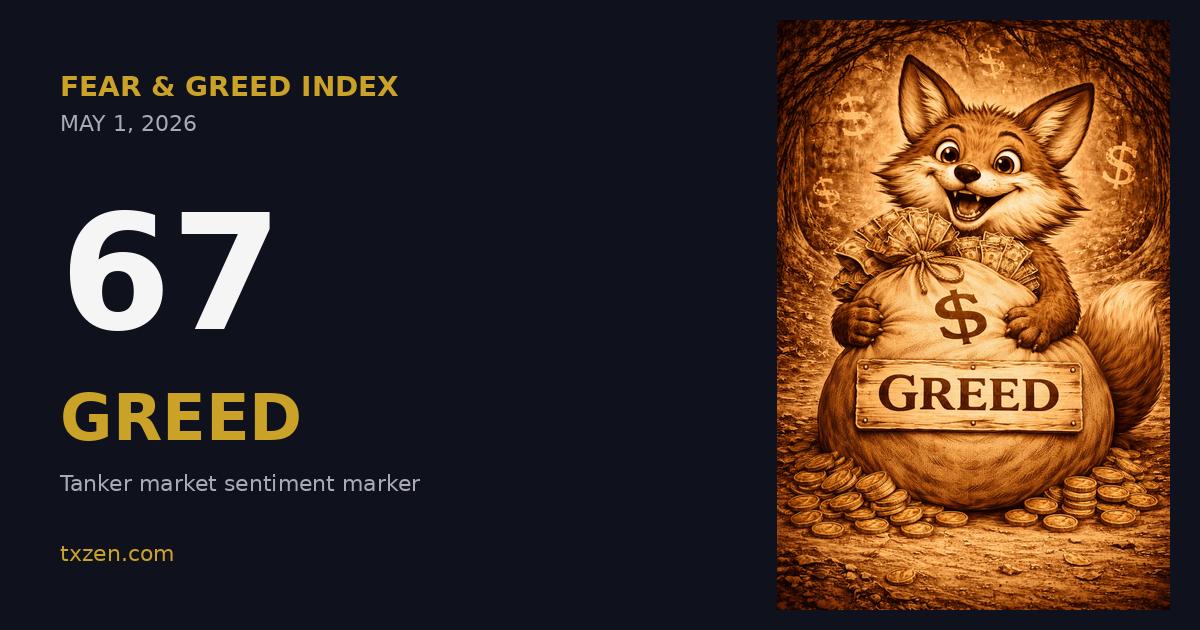
The CNN Fear and Greed Index closed at 67 on May 1, 2026. That puts retail and institutional sentiment squarely in Greed territory. The reading matches yesterday’s close at 67, which means the market is parking, not running, at this level. For tanker investors watching the broader risk tape, a steady reading in Greed says capital is willing to hold positions and look for upside. It is not euphoria. It is not panic. It is the market settling into a confident posture as the calendar turns from earnings season to summer trading.
Track tanker stocks live on TradingView.
The Fear and Greed Index is 67 today
Sentiment: Greed
Our fox friend is clutching that money bag tight. Greed is driving the market.
A reading of 67 is the part of the cycle where stories win and tape readers stop arguing.
What a 67 print means right now
Sixty-seven sits inside the Greed band, which runs from 56 to 74. The band above it, Extreme Greed, starts at 75. The band below, Neutral, ends at 55. So the reading has room to push up before it triggers the contrarian alarm bells that come with Extreme Greed prints in the high seventies and eighties. It also has room to slip back to Neutral if any of the seven inputs deteriorates.
Greed at 67 historically lines up with markets where the put to call ratio is calm, junk bond demand is firm, and the McClellan Volume Summation Index is constructive. Pull any one of those and the score moves. The tell for retail investors is that 67 is not a buy signal and it is not a sell signal. It is a posture signal. It tells you what the room is doing right now, not what the room will do tomorrow.
Why sentiment matters for tanker stocks
Tanker stocks do not move on the Fear and Greed Index. They move on time charter equivalent (TCE) rates, vessel asset values, and order book discipline. But sentiment does affect the multiple the market is willing to pay for those cash flows. When the index parks in Greed, multiples expand. When it slips to Fear, multiples contract even when underlying fundamentals do not change.
That is why a 67 print matters for the watchlist. Frontline, DHT Holdings, Scorpio Tankers, Teekay Tankers, Hafnia, Euronav, International Seaways, and Ardmore Shipping all benefit from a market willing to look through near-term rate noise. In Fear, those same names trade at single digit price to earnings ratios with steep dividends getting punished as if they were one-time payouts. In Greed, those same dividends are rewarded as durable income and the multiples drift back toward the long term average.
The trade is not to chase Greed. The trade is to know which names you would buy if Greed flipped to Fear, and to keep that watchlist updated each week as the index moves.
Sentiment does not create cash flow. It creates the multiple the market is willing to pay for cash flow.
The trend behind today’s reading
Yesterday’s close was also 67. Two days at the same level inside Greed signals a stabilization, not a trend. The chart has stopped accelerating up and has not started rolling over. For the week, the index has held inside the Greed band for the entire run. That is the kind of grind it out pattern that often precedes a binary move when the next macro catalyst hits.
The catalysts on the calendar that could move sentiment include the next round of payroll data, OPEC plus production decisions, and any United States and China trade headlines. Tanker investors should also watch crude inventory data and the Suez Canal and Strait of Hormuz news cycle. Each of these has the power to push the Fear and Greed reading up or down by ten points in a single session.
What is the Fear and Greed Index?
The CNN Fear and Greed Index measures market sentiment on a scale from 0 to 100. A reading of 0 means Extreme Fear. A reading of 100 means Extreme Greed. The index tracks seven indicators.
Those indicators are market momentum measured by the S and P 500 versus its 125 day moving average, stock price strength measured by 52 week highs versus lows on the New York Stock Exchange, stock price breadth measured by the McClellan Volume Summation Index, the put to call options ratio, junk bond demand measured by the spread between investment grade and high yield, market volatility measured by the VIX and its 50 day moving average, and safe haven demand measured by the relative performance of stocks versus Treasury bonds. Each input is normalized to a 0 to 100 scale. The headline number is the average.
How retail investors should read this
Treat the index as a thermometer, not a stop sign. A high reading does not mean sell. A low reading does not mean buy. What it does is force you to ask whether the price you are paying for a name reflects fundamentals or reflects what the room thinks about fundamentals right now.
In tanker stocks, where the cash flow story can disconnect from the headline tape for weeks at a time, that question matters. A name trading at three times forward earnings during a Fear reading is often a better entry than the same name trading at six times forward earnings during a Greed reading, even if the underlying daily charter rate is the same. The Fear and Greed Index gives you the discount or the premium the market is applying. Your job is to decide whether to accept it.
Where 67 sits in the cycle
Looking at the historical Fear and Greed range, mid sixties readings have a mixed record as forward indicators. They sit close to the long term average score, which over multi year windows has hovered between 45 and 55. So a 67 print is above average but well below the historical extremes that have marked turning points. The recent peaks above 75 in the Extreme Greed band have often coincided with broad equity tops within a few weeks. The recent troughs below 25 in the Extreme Fear band have often preceded relief rallies. Mid sixties readings have done neither reliably.
For the tanker watchlist, that means a 67 reading is not the time to add aggressively and not the time to lighten up wholesale. It is the time to do the homework that will let you act decisively when the next extreme print arrives. That homework includes refreshing TCE assumptions on each name, checking dividend coverage at current spot rates, and noting which balance sheets can take a charter market dip without cutting payouts.
The signal versus the noise
One thing to watch with sentiment readings in this range is divergence. If the Fear and Greed Index stays in Greed while tanker rates soften and tanker share prices weaken, that divergence becomes a tell. It means the broader market posture is supporting multiples that the underlying cash flows no longer earn. The opposite divergence is also worth watching. If the index sits in Fear while tanker rates climb and asset values firm, that gap creates the kind of asymmetric setup that disciplined investors wait for.
For now, with the index at 67 and tanker fundamentals broadly constructive, there is no divergence to trade. The signal and the cash flow agree. That is a calm posture, and calm postures rarely last in tanker shipping.
Yesterday’s close: 67
Data sourced from CNN Business. Posted automatically by StemGauge every Friday as a sentiment marker for the txzen.com tanker stock watchlist.